"How to Grow Delicious Vine Ripened Organic Tomatoes With Liquid Organic Tomato Fertilizer"
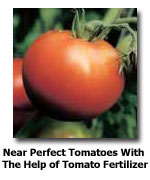
Growing bunches of big red juicy tomatoes with natural organic tomato fertilizer is easy.
My favorite summer time garden event is to walk out back to the garden and see clusters and clusters of tomatoes just a day or two away from being a beautiful full ripe red and knowing exactly what was used to grow them, including the natural tomato fertilizer.
I love the summer days when so many delicious garden fresh tomatoes are coming ripe that you have to fill up baskets and give em away because you have enough to eat and for canning for the next year.
But it was not always this way. I remember when I could barely get the tomato plants to grow. And when I did get them to grow they would not come ripe or blossom rot would tragically take my tomatoes.
I had to find the right natural tomato fertilizer and know a few simple secrets on how to grow tomatoes to be large, juicy, and abundant.
Imagine this... you produce bunches and bunches of the best tomatoes with all natural tomato fertilizer to feed your family, friends, and neighbors with all natural, garden fresh, nothing like it at the store, juicy organic tomatoes from your garden.
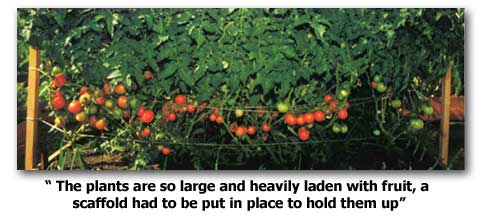
More Tomatoes Than Ever Before
"...normally I don't have any ripe tomatoes until at least the last week of July or the first week of August. Today is June 24: I've been eating cherry tomatoes from my vines, and I have more tomatoes, more fully developed than any I've ever been able to grow before. I have changed nothing in the method I've used to raise these tomatoes other than to use your Natural Fertilizer."
Richard Gould, Investment Counselor and Home Gardner
Tomatoes Plants Grew Over 6 Feet And Doubled In Size
"...I fertilized half of the garden with your Natural Organic Fertilizer and the other half with my regular commercial fertilizer. The results were absolutely amazing. Green pepper plants which usually would bear three or four peppers per plant were producing as many as eight and nine peppers per plant and had increased the size of the fruit by at least one-third. The tomato plants which normally would grow to a height of 3 to 4 feet were up over 6 feet, had bushed out double their normal size, and then produced at least twice as many tomatoes as the non-Natural Fertilzer fertilized plants with large and better fruit on top of it."
Toby E. Marcovich, Attorney and Home Gardner
Grows Better Than Miracle Gro
"...worked with a Washington, D.C. gardener who conducted an experiment with three tomato plants. One received no fertilizer, one got Miracle Gro and one was given our Natural Fertilizer. The plant that received no fertilizer was 3 feet tall. The plant that got Miracle Gro was a little taller. The plant that received your Natural Fertilizer was over 4 feet tall. The plant was full of leaves and fruit production was greatly increased."
Gerry Reid
Won First Place In Iowa Jumbo Tomato Contest
"I have had an exceptional yield of tomatoes with good taste, and entered a tomato in the Jumbo Tomato Contest at the 1992 Iowa State Fair. The tomato weighed in excess of 2.75 pounds and won First Place."
Bob Davenport, Master Gardener
30% More Tomatoes On Each Vine
"Using your recommended mixture of fertilizer to water, I sprayed my 10 acres of tomatoes about fifteen days after planting my plugs. I then sprayed again using the recommended mixture when my tomatoes showed their first bloom. The result was about 30% to 40% more tomatoes on each vine. I am presently harvesting my 10 acres with profound results. The tomatoes are much larger than I have had in prior years using granular fertilizer."
Dan Shisko - Organic Produce

When it Comes To Growing Massive Tomato Plants With Meaty Yields...
You can not beat a good composting system as your premier source of fertilizer and here's why:
because in addition to recycling essential nutrients into your soil the compost brings in a healthy microbes balance that works symbiotically in the soil to make all the nutrients available to the tomato plants.
It is the microbes that make the big difference...
And the other great thing about prolific amounts of good microbes is... they are delicious worm food that draw more worms into your garden.
Earthworms Are The Greatest Thing That Ever Happened to Your Tomato Garden...
Earthworms are like little rototillers for your garden that come with an organic fertilizer discharge chute... so you get free fertilizer applied while these little workers endlessly process and cultivate your garden soil.
I learned at a young age working in Grandpa's garden that earthworms are a sign of a healthy garden and when using a shovel in the garden you should avoid harming the worms when you see them.
In fact anytime us grand kids would discover a worm outside of the garden Grandpa would send us out back with it to place in with the tomatoes and vegetables.
Please Don't Kill Your Worms With Chemical Fertilizers
So how do earthworms feel about chemicals being added to the soil? Can you imagine pouring chemical fertilizer on top of a small pile of your friendly earthworms and seeing what would happen to them?
Poor little guys would be mighty uncomfortable and if the chemical fertilizer was spread through out their garden world then their microbe food supply would be killed off.
The warnings on the side of fertilizer bags instruct humans and pets to stay off freshly fertilized areas... well if it is harmful to people and dogs then it should have a worm warning too!
Chemicals are not good for the worms and they sterilize the soil and kill off the microbes that worms eat. It reduces numbers and with continued application the natural ecosystem in your soil will shut down and become addicted to to your chemical application to achieve mediocre results...
We need to grow the worm population by growing their food source... the soil microbes.
What If I Don't Have A Compost Pile?
Composting can be a hassle to get started and depending on where you live maintaining a compost pile may not fit into your living arrangements. Without compost it is still critical to get the soil microbial activity up so your garden tomatoes can thrive.
This is where a good fish emulsion with kelp can help. Testing has shown soil microbe activity to increase over 2000% over previous tested levels in just two weeks. So two weeks after you apply a dilute solution of fish emulsion and kelp fertilizer (with a touch of molasses in the blend) you ignite the microbe activity in your garden soil. I mean the number of active microbes in your soil shoots through the roof!
This in turn attracts massive populations of earthworms which work non stop in your garden soil to naturally create the ideal growing environment for tomatoes.
So to get the soil microbial activity raging to attract the worms add some fish emulsion to your watering barrel at just 2 oz per gallon and apply to the soil around your tomato plants. You only have to do this a few times during the growing season to see great benefits.
Do it when you first plant, when the plants first flower, then when the fruits set in.
Tomato Plants Have A Huge Sprawling Root System - Careful Not To Kill Them
Tomatoes have an elaborate root system that will grow out to nine feet from a mature plant. This is why it is important to not cultivate in in the garden around the tomato plants. Any cultivation is actually damaging the root system of the tomato plant and stressing the plant! To get the best tomato fruits and to get the highest yield we need to minimize damage to the plant and damage to the roots and keep the tomato plants stress free to produce record growth.
Yes, tomato plants get stressed out... they don't like their roots cut or compacted, they don't like ice cold water, and they don't like chlorine in their water!
Because of the way the tomato root system spreads around the plant application of the fish emulsion to the garden surface in a 3 ft circle around the stem of the plant is the best way to get "food" to the plant.
The tallest tomato plant in the world was a cherry tomato plant that topped out at 28 ft tall! The person that grew these gigantic and prolific tomato plants understood how to apply a thin layer of compost over top of of the soil surrounding the tomato plant. It took him 5 years to perfect his various strategies to get to world record growth.
So if you do or don't have your own compost that includes cow manure that heated the compost pile to at least 160F for two days then you might want to take the easier path and apply liquid organic tomato fertilizer after you order right now.
Strangely enough this organic fertilizer is made from the Atlantic Menhaden fish and Menhaden means "that which manures". So it is Atlantic fish manure that is proven to improve your tomatoes.
Do Not Compost Your Tomato Plants Or Let Your Tomatoes Lie In The Garden Till Next Year
If you have ever had any problems with tomato blight or other tomato diseases you may have already learned that many of these disastrous problems come from fungi that live in the soil.
If you have a tomato plants that showed any signs of disease you just need to dispose of the plants at the end of the season somewhere far far away from your garden. The wind can blow the fungi spores into your garden soil and any diseased plants or tomatoes that are left to lie in your garden at the end of the year will just propagate the diseases into your next growing season.
It is very very important that you cover the soil around your new tomato plants so the soil does not splash up on the plants when it rains or when you water. Doing so keeps all the soil borne tomato disease from infecting your plants.
It is simple to do and very effective.
It is also a good idea to burn off any vegetation on your tomato cages with a weed burner to kill off any diseases from the previous years (do this before you put them to use obviously)
Please Don't Use City Water On Your Tomatoes
The chemical industry has done a wonderful job of promoting the worship of the almighty "N-P-K". The grand idea is you can take your soil analysis, determine what ratio of NPK you need to add, apply chemicals and cross your fingers and hope for good weather. One problem is these salt based chemical fertilizers do not chelate in the soil and 95% of the fertilizer ends up as run off.
And...
The really big problem is these chemicals kill off beneficial bacteria in your soil. The very microbes that promote stellar growth and yield naturally are destroyed with each chemical application.
The chemical industry does a great job of covering up the importance of the bacteria in your soil and leading all of us to believe that all you need to know are three little numbers named N-P-K and this is just flat out wrong (and even dangerous long term).
So what is wrong with city water? It is heavily chlorinated to kill all the little bugs in the water that could make you sick... but chlorine kills the bugs in your soil too! If you have city water it is probably heavily fluoridated. You will actually accumulate fluoride in your soil by using city water.
City water is sterilized to prevent water borne illness in humans but city water will also sterilize the soil in your garden!
If you absolutely have to use city water then fill your water into an open topped barrel or bucket and let it sit for at least day. This allows the water to warm up and allows a lot of the chlorine to evaporate out.
Your probably familiar with this technique if you have ever owned gold fish. You have to let the tap water sit a day before placing the fish it because it will poison the fish with chlorine.
It Is Best For Your Tomatoes If You Water Using...
a rain barrel or pond water if you can. If you have well water that is great too but be sure to pump it up into a barrel or bucket and allow it to warm up before you water your tomatoes.
Plants get stressed out kind of like humans do and the less stress you cause the more likely your tomatoes will thrive! Don't water your garden plants with cold water.
How to Solve Blossom End Rot Once and For All
Have you ever had a great stand of tomatoes coming in only to notice as they came ripe that there was a dark spot growing on the ass end of the tomato... yes the dreaded blossom end rot. Thankfully this is a very simple condition to prevent.
An otherwise perfect tomato is ruined...
Blossom end rot actually means the tomato plant has a calcium deficiency which you can correct for future tomato growth.
This problem is made worse by uneven and sporadic watering which places additional stress on the tomato plant. Be sure to place some straw mulch over top of the soil to keep the direct sun from overheating and drying out the soil.
The straw will help the soil retain moisture and keep and even out the supply of water to the tomato plants.
To remedy the calcium deficiency be sure and add one quart of liquid bonemeal 0-12-0 for every 1,000 sqft of tomato garden soil before the next growing season.
A Simple Solution For Tomatoes That Crack!
When I discover a tomato that has burst itself open I first check to see if any critters have gotten inside. If I beat the red ants to the punch I usually harvest immediately and bring the tomato in to safety. From there the family chef decides when and where to use.
I rarely have to deal with split tomatoes anymore now that I know the simple solution to the cause.
Tomatoes are like many other plants when they are stressed with a drought they are prone to taking up excess water rapidly when it becomes available.
So if you let your tomato garden soil get too dry then you water them heavily the tomato plants take up water so aggressively that they split their own fruits open.
Again this is simply remedied by using mulch. Mulch shields the soil from the drying and overheating effects of direct sunlight. Gentle watering a few times per week to keep the soil moist (not wet) is your best protection against radial tomato cracks from the stem.
The worst thing that can happen is you allow your tomato soil to dry up and then a torrential rain comes through... you are just about guaranteed to have problems then. We can't control nature but we can set ourselves up to have the best chance of surviving heavy continuous rainfall by having a consistent and even watering schedule with a nice straw covering to protect the soil.
Keep Your Garden Soil Off of Your Tomato Plants Or Suffer Losses
It is worth mentioning again that you want to keep your soil covered around your tomato plants. If you can keep the soil from splashing up on the plants when it rains or when you water the garden then you have an immensely higher chance of having healthy disease free tomatoes.
Remember all the little fungi that cause tomato disease are hanging out down in the soil... if they can't get on to the plants they cant cause problems.
Keeping the soil of the plants is the most effective way of preventing tomato blithe from coming through and destroying your entire tomato garden.
Step By Step How To Grow Great Tomatoes With Tomato Fertilizer
Transplanting:
Dig holes 2-3 feet apart, 8-12 inches deep with 3-6 foot row spacing (closer together for staked plants)
1) Pinch of all except top two or three leaves at the stem
2) Plant in hole up those leaves burying most of the stem. The buried stem will send out roots and this helps the plant produce earlier.
3) If soil is shallow then plant horizontally with the tip turned up gently.
Fertilizing
1) Till in a layer of compost in fall or early spring (about 2 inches). Use a 2:1 soil/compost to fill holes when transplanting.
2) Mix two ounces of 4-3-3 tomato fertilizer with one gallon of water and soak the bottom of the hole before transplanting: right after transplanting water the plants with the same tea.
3) For the highest yields use tow ounces of 4-3-3 Fertilizer, two ounces of 0-12-0 bonemeal, and one ounce of 0-0-8 per gallon of water at planting.
4) Sprinkle with Fertilizer tea at first bloom, full bloom and during fruit set as cooler nights set in.

How A Man In Small Town Arkansas Grew a World Record Cherry Tomato Plant to 27' 8" Tall
Did you know the gentleman that broke the world’s records for the tallest cherry tomato plant at nearly 28ft tall also set the world record for producing over 1300 lb of tomatoes from only four tomato plants? He admitted that his secret to enormous tomato plants was using compost.
He confessed that his overall tomato growing strategy took him 5 years to perfect but it was so simple that no one would ever believe his method for growing his record tomato plants.
In fact he could probably tell his world champion competitors exactly how he grew record tomatoes without fear that they would break his record because everyone thinks there has got to be a "miracle secret formula" to growing prolific meaty delicious tomatoes that he is just not sharing.
He even had university professors try to intimidate him to force him to reveal his "secret" even though he had already told them his exact and complete system for growing tomatoes.
Which Fertilizer Did He Use To Get 1300lb of Tomatoes From Only 4 Plants?
No one would believe his giant tomato plants with record production could be achieved without adding some special chemical blend. Well the chemical N-P-K worshipers of the world just can not believe what you can accomplish naturally with compost and promoting the growth of your beneficial soil microbes.
Though he said he did not have any secrets I consider his compost the "secret sauce". He had specific quantities of different ingredients and simple methods of making sure his compost piles got hot and stayed moist (not wet).
and he did share his compost recipe which included cow manure to "heat it up" as he said. This literally means he would mix green kudzu leaves and other matter with cow manure and let it heat for a couple of days to at least 160 degrees Fahrenheit.
Why Did His Special Compost Mix Work So Well?
So if it is as simple as using compost then how exactly does that work?
The simple answer is when you let nature run its natural course of recycling nutrients back to the soil you create the opportunity to grow some massive tomatoes. This is where soil microbes come in to action...
It is the beneficial microbes in the soil that eat the dead organic matter in the soil or in the compost pile and excrete food for the plants.
Some beneficial microbes even eat other non beneficial microbes and turn those into plant food.
Billions Of Soil Microbes Found In Just A Thimbleful of Soil
Did you know a thimbleful of healthy soil contains several billion microbes including fungi, bacteria, actinomycetes and algae. When the balance of good microbes is tipped favorably and these little guys are fed well then your tomatoes are in turn fed very well which means you get great tasting tomatoes and more of them.
These soil microbes produce their weight in humus every single day making the most bio available nutrient sources readily available to the roots of your tomato plants. The more beneficial microbes the better your tomato plant growth and the more tomatoes you get (that taste better too).
Beneficial Soil Microbes Put Natural Nitrogen Into Your Garden For FREE
Your soil microbes also fix up to 100 lbs of nitrogen per acre into the molecular forms the plants can easily use.
This is very different from spreading the common chemical version of nitrogen, aka ammonium nitrate, which damages the natural ecosystem of microbes in the soil. In fact research has shown that up to 96 percent of high analysis chemical fertilizers are not even taken up by the plants. That means 96% of chemical fertilizer ends up as run off... a huge waste and a damaging challenge to the environment.
So the plants are not even using the chemicals and the chemicals that are supposed to be helping are actually killing the good microbes in the soil which are making the humus and worm food in turn feeding the tomato plants. Chemicals are not only bad they are double bad. Your garden will end up completely addicted to chemical fertilizers as your soil microbes are killed off.
Feed The Microbes and They Feed Your Tomatoes
On the other hand, with increased levels of beneficial microbes your need for external fertilizer is eliminated. You just have to feed your microbes what they love to eat, organic material from your compost pile.
And this is where the earthworms come in to play. Worms love to eat microbes and this is good for you because if you increase your beneficial microbes you create more food for the worms which attracts even more worms.
Earthworms are the natural rototillers keep your soil pliable and they leave a very delicious plant food called worm castings.
More Microbes = More Earthworms = Giant Tomato Plants
Did you know in healthy soil earthworms will produce 700 lbs of worm castings per acre per day. Wow! Can you see why you want to protect your soil microbes and keep our friends the earthworms well fed and happy.
Here is the key to protecting your soil, if you apply chemicals or chlorinated city water to your tomato garden you very well could be killing off your beneficial microbes and driving away the earthworms. This is why industrial chemicals are disaster for your garden long term.
On the other hand feeding and multiplying the microbes and the earthworms in your soil is like flipping a switch and turning your soils natural tomato production capability to “on”.
Anything you do that harms this subsurface ecosystem will equal weaker tomato plants and anything you do to enhance the subsurface ecosystem promotes giant prolific tomato plants. So let’s flip your soil switch to "on" and really grow some tomatoes.
Fish Emulsion Fertilizer Flips The Switch and Turns Your Tomato Production To "ON"
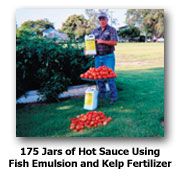
This is the secret of our fish emulsion fertilizer... It flips the switch on your soil to "on" and ramps up the beneficial microbial activity in your soil. But not all natural fertilizer does this… so listen up.
When you blend up a recipe of natural fertilizer you have to look at each component and what is does to the soil microbial environment.
Applying low levels of natural nutrients such as fish, kelp, humates and corn gluten meal stimulates the proliferation of microbes and earthworms. I call it the explosion of microbial activity the "firestorm" in your soil. Microbes and earthworms create all the raw soil ingredients tomato plants need to grow to record proportions.
Soil Microbes Increases 2000% Two Weeks After Fish Fertilizer Applied
Applying our fish emulsion kelp blend has been tested and it increases the soil microbial counts by over 2000% in two weeks.
These little workers in your soil produce their weight in humus every single day. Because you have more microbes you get 2000% more humus produced in your soil everyday which is 2000% more tomato food to practically force your tomatoes to grow vertical.
Can you see why the world record breaking tomato plants achieved their status without chemicals (which kill soil microbes) but instead with a focus on the amazing natural process that is already taking place in your soil.
This natural cycle in your soil is accelerated by using our fish emulsion tomato fertilizer. As the creatures in the soil multiply, they excrete nutrients and die or are consumed, digested and excreted by other organisms, releasing more nutrients as your tomato plants need them.
You help your plants reach their impressive potential by flipping the switch and turning your soil on.
You might think it is as easy just spreading some manure around your tomatoes and giant tomatoes pop out but that couldn't be further from the truth.
Beware... Natural Fertilizers Are Not Created Equal
You see a lot of companies continue to shovel chicken droppings and other animal droppings into bags and sell these as natural or even organic fertilizers for your tomatoes. Now many of these products have their place for certain agricultural uses but unfortunately to the unsuspecting tomato garden these products don't stimulate the soil activity like a tomato fertilizer formulated with fish, kelp, humate, and corn gluten meal.
In fact some of these other products will cause more harm than good. I suggested you start some plants in multiple different pots of fertilizers to see for yourself. More is not always better and may destroy your tomatoes from day one.
And then there are those other fertilizer products out there which are fish based but don't have the kelp and don’t have the molasses and the other key ingredients that we have tested. Our other ingredients work together with the fish emulsion base to positively activate the soil in your tomato garden.
The stand out difference between our fertilizer and the others is our formulation is just that "formulated". We don’t simply shovel manure into a bag and call it fertilizer. And we don’t just grind up fish willy nilly from around the world and call it a fish emulsion.
Our formula has been carefully and meticulously formulated to grow tomatoes and your other favorite vegetables. It has been engineered using natural sources and ingredients and tested on plants in multiple studies over decades with an enhanced blend of natural ingredients that outperforms chemical fertilizers and other natural fertilizers.
In fact there are over 60 naturally occurring major and minor nutrients in the fertilizer blend and the raw ingredients are sourced from the same locations and same fish to insure a repeatable fertilizer performance.
I tell you this because a lot of fertilizer out there is made from whatever waste material is the cheapest to purchase on any given day and two bags of the same product will perform differently. You have to formulate, test, then control the manufacture and production to make sure you get the huge results you promise.
How A Tiny Fish From The Gulf Of Mexico Boosts Tomato Yield
The fish emulsion is based upon the remains of Menhaden fish out of the Gulf of Mexico. The fish are harvested to be pressed to extract the beneficial fish oil for human consumption and the leftovers, instead of being wasted, are processed to make the essential ingredient for tomato fertilizer.
The Menhaden fish are prepared for your tomatoes using our proprietary low temperature enzyme process... to carefully preserve the amino acids, minerals, and vitamins. This process creates smaller “bite size” molecules for your tomatoes to easily absorb through their roots and through their leaves as a foliar application.
It was interesting to discover the name Menhaden comes from the word “munna whaleaug” which means “that which manures”... and were used by Native American for centuries to grow their crops.
Icy North Atlantic Kelp Provides Plant Growth Hormones To Boost Tomato Size
The kelp comes from the Icy North Atlantic waters off the coast of Canada contain high levels of plant growth hormones, amino acids, micronutrients and potassium which provides increased heat, cold, and drought tolerance for your tomatoes.
Sulfate of Potash From The Great Salt Lake in Utah To Improve Tomato Fruit Quality
Sulfate of potash from the Great Salt Lake is used because it provides potassium without the root damaging chloride (Cl) atom attached. Without potassium your tomatoes are more susceptible to insect attack, have weaker stalks, and are underdeveloped.
Sufficient potassium allows your plants to produce high quality tomatoes.
Dark green leaves, high nutritional quality, firm stalks, prolific root growth, greater plant vigor, improved nutrient uptake, higher yields, fewer blemishes, increased disease and insect resistance.
Here Is Your Tomato Garden Triple Booster Pack
Here's what you get:
You get one quart of 4-3-3 fertilizer... enough to treat a 500 sq ft of tomato garden 4 times. And you get one quart of 0-12-0 Bonemeal and treat up to 2000 sq ft of soil before the next growing season and you get one quart of 0-0-8 Liquid Kelp to apply with the 4th application of 4-3-3. That's less than $30 for enough tomato fertilizer to last you for years to come... plus you can fertilize of your vegetables and flowers with the same 4-3-3 fertilizer which will:
- Increase beneficial soil microbial counts over 2000% which turns your soil into its own tomato plant food factory...
- Help eliminate your chances of blossom end rot by solving your Ca deficiency problems
- Increase your tomato plant size
- Increase the size and number of vine ripe tomatoes you get from each your tomato plants
- Improve your tomato flavor for the best tasting garden fresh tomatoes possible (and chemical free)
- And a chemical free solution that will outperform your neighbors who use miracle gro (you will have them scratching their heads when you tell them you don't use chemicals)
- You save money over chemical fertilizer and don't have to worry about the kids, grandkids, touching or eating anything straight from the garden.
Your organic fertilizer will arrive in easy to handle quart size jugs and will quickly deliver to your doorstep from one our regional warehouses. (If you have a large tomato crop and need larger quantities we have 2 1/2 gal jugs and 55 gal drums and 250 gal totes too.)
PLUS, is you send me an email with your order confirmation number I will send you a free electronic copy of the "Ultimate Guide To Growing Tomatoes" currently selling for $29 (you can see it here). Shoot me and email which includes the text "Ultimate Guide to Growing Tomatoes" after you order and I will rush you a special link to download your copy.
Look, in the very short time we have had together, I've shown you how easy it is to increase your tomato yields at least two times over the conventional approach of growing tomatoes...
...And I've covered the importance of watering with chemical free rain water at ambient temperature to protect your precious soil microbes (this alone can turn a tomato garden into hyper production)
...And I've shown how important it is to keep soil from splashing up on the leaves of tomatoes to prevent the destruction of your tomato plants from soil borne disease like blight and others.
...And I've proved that chemical fertilizers sterilize your soil and work against you growing strong healthy tomato plants year over year
...And I've demonstrated, in depth, the key to prolific and delicious tomatoes is stimulating the beneficial microbes in your garden soil that naturally convert organic matter into tomato food (not to mention bringing in an army of earthworms to cultivate your soil and further fertilize with worm castings)
...And finally I have documented how my liquid organic fertilizer uses fish emulsion, kelp, humates and corn gluten to "flip the switch" and turn on the beneficial microbes in your tomato garden soil to practically force your tomato plants to produce the meatiest and most tomatoes per plant...
OK, well since we see eye to eye on all this – then doesn’t it make sense to take action and get some tomato fertilizer right now?
Go ahead and click the "order now" button and you will be taken to the tomato fertilizer order page. From there you will enter our secure order processing cart and after you enter the address to where your fertilizer is shipping you can rest assured your tomato boosting fertilizer is on its way.
Yours For A Fantastic Tomato Garden!
Tina
FIELD TOMATO PRODUCTION - Natural Tomato Fertilizer Outperforms Chemical Fertilizer in Actual Field Test!
Field tomatoes require sufficient levels of macro and micronutrients to set fruit. Calcium (Ca) and potassium (K), and nitrogen (N) are especially critical. Insufficient levels of these nutrients produce diseased plants and poor quality fruit. The application of all natural fertilizer products, biological activators, and/or aerobically composted manure (or other material), inoculates the soil with microorganisms. The microbes convert natural fertilizer nutrients and fix atmospheric nitrogen into plant available nutrients which speeds plant growth and development.
Soil Applicants:
Once seedlings have emerged and have developed 2-3 true leaves, begin fertilizing the soil. When planting transplants, water the plants with fertilizer solution. Rates are given for monthly applications. Adjust rates accordingly when applying more or less often.
1.) Mix 2-3 gallons 4-3-3 Natural Fertilizer, 2-3 gallons 0-12-0 Natural Liquid Bonemeal, and 1-2 qts 0-0-8 Natural Kelp and Sulfate of Potash with at least 100 gallons of water. Apply solution to one acre.
2.) Keep well watered between fertilizations.
Banded Soil Applications:
Mix 3-4 gallons 4-3-3 with 6-10 gallons of water (use enough water to allow correct flow rate through the micro tubing). Apply below and to the side of the seed or transplants at planting. Apply solution to one acre. The addition of 1-2 gallons of 0-12-0 and 2-4 qts of 0-0-8 along with 4-3-3 may also be beneficial especially when phosphorus soil test levels are below 40 ppm and potassium soil test levels are below 150 ppm.
Pre-Plant Soil Applications:
Mix 3-6 gallons of Natural Organic Fertilizer 4-3-3 in 20-30 gallons of water. Apply solution to one acre (apply spring and fall if soil is hard and low in organic matter).
Foliar Applications:
All Natural Liquid Organic Fertilizer 4-3-3 can be applied to the leaves of tomatoes to supply additional nutrients. Mix 1-3 gallons of Natural Fertilizer 4-3-3 with 50-100 gallons of water and apply as a fine mist to the tops and bottoms of leaves. Apply enough solution to wet the leaf surfaces. Apply in 14-21 day intervals after the plants reach 2-3 true leaves. The critical stages for foliar applications are 2-3 true leaves; pre-bloom, and early cluster formation.
Rates vary according to other inputs that are applied. Lower dilution rates are more effective than higher dilution rates. Two or three lighter applications may be more effective than one or two heavier applications. If other constraints allow only one application, then do not exceed a 3% dilution rate (3 gallons of Natural Organic Fertilizer to 100 gallons of water).
The addition of a biodegradable surfactant increases uptake by increasing adhesion to the leaf surface. Apply Natural Organic Fertilizer in early morning or late evening. Do not apply before or after rainfall or irrigation. On standard field sprayers, use turbo flood jet nozzles when applying Natural Organic Fertilizer to reduce clogging.
GREENHOUSE TOMATO PRODUCTION
Greenhouse tomato production requires sufficient levels of macro and micronutrients to set fruit. Calcium (Ca) and potassium (K) are especially critical. Insufficient levels of these nutrients produce diseased plants and poor quality fruit.
Development of an organic system that stimulates rapid early growth and development is critical. The addition of a biological activator, aerobically composted (or other material), worm castings, or used potting mix inoculate the media with microorganisms. The microbes convert natural fertilizer nutrients and fix atmospheric nitrogen into plant available nutrients which speeds plant growth and development.
Planting Mix:
1.) Mix peat moss, perlite, and coarse vermiculite in a 2:1:1 ratio.
2.) Substitute sandy loam, pumice, compost, castings, and etc. for part or all of the vermiculite.
3.) Add 5 lbs of high calcium lime and 2.5 lbs of dolomite lime to one cubic yard of mix.
4.) Soak the media with enough water to thoroughly wet the peat moss. Mix 1 gallon of Natural Liquid Lime and 1 qt. of 4-3-3 Natural Fertilizer with the water and add to one cubic yard of mix. Use a wetting agent to aid in wetting the mix. Add a biological activator to further stimulate biological activity.
How Do I Get It?
For more information on Natural Organic Tomato Fertilizer or to order you can Click Here for tomato fertilizer